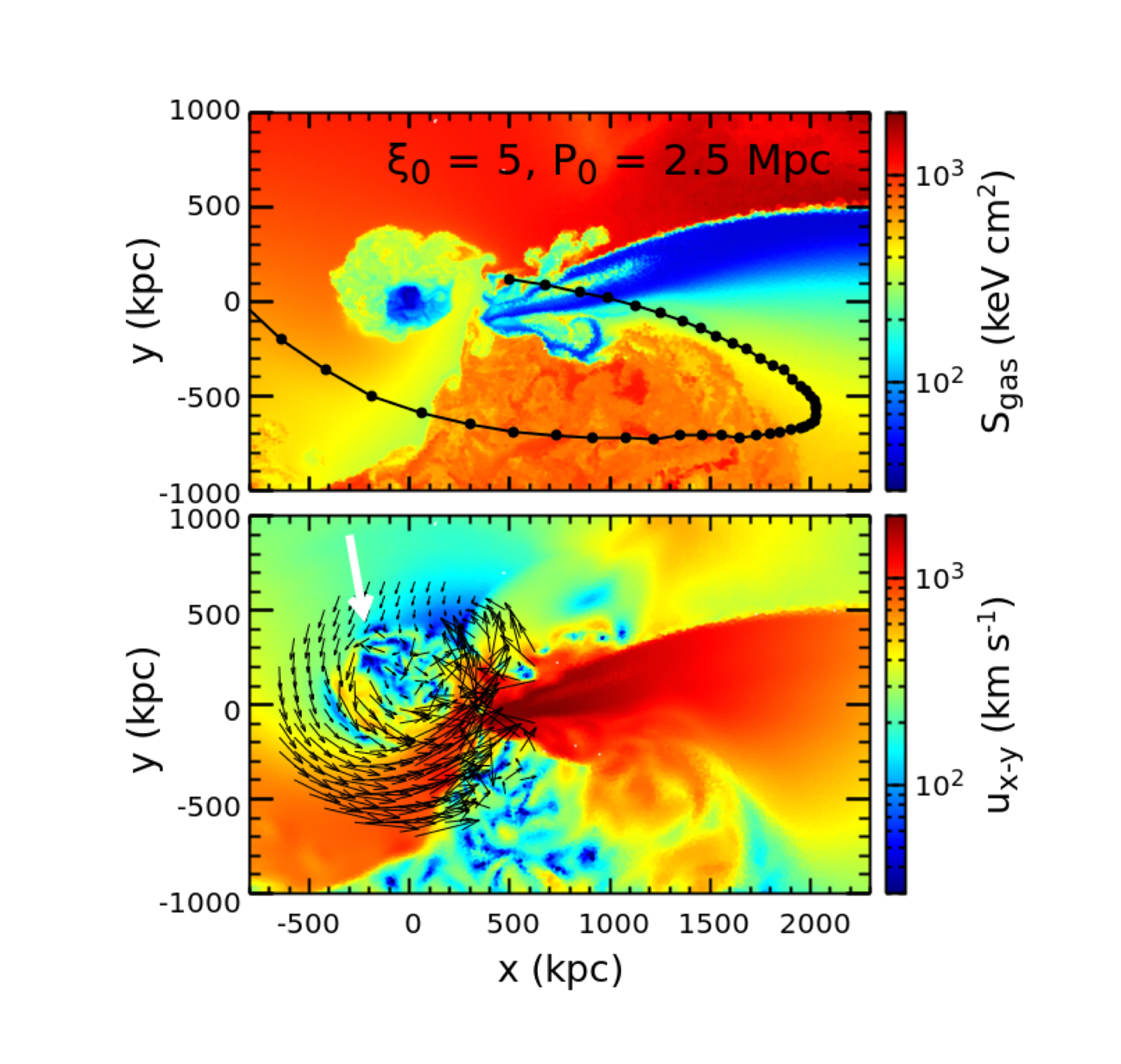
In parallel with our observational research, our group is involved in theoretical studies, development of numerical simulations and analyzes large datasets from cosmological simulations to explore the physics of various intracluster medium processes. Our idealized hydrodynamical simulations, or "toy models," are effective at reconstructing the merging geometries of galaxy clusters, the propagation and interaction of shocks, the physics of cluster outskirts, and a number of processes involved in AGN feedback, including those that are important but often missing from many large-scale simulations. Our suite of radiative transfer simulations is especially useful in this era of high-resolution X-ray spectroscopy for modeling resonant scattering and polarization in galaxy clusters. We also analyze cosmological simulations, which model many processes all at once. These simulations are particularly useful for calibrating our observational tools and exploring the capabilities of current and future X-ray missions.
Selected relevant publications:
Zhang C., Zhuravleva I., Gendron-Marsolais M.-L., et al. Bubble-driven gas uplift in galaxy clusters and its velocity features. MNRAS, 517, 616 (2022).
Zhang C., Zhuravleva I., Kravtsov A., et al. Evolution of splashback boundaries and gaseous outskirts: insights from mergers of self-similar galaxy clusters. MNRAS, 506, 839 (2021).
Zhuravleva I., Churazov E. M., Schekochihin A. A., et al. The Relation between Gas Density and Velocity Power Spectra in Galaxy Clusters: Qualitative Treatment and Cosmological Simulations. ApJL, 788, L13 (2014).
Zhuravleva I., Churazov E., Kravtsov A., et al. Constraints on the ICM velocity power spectrum from the X-ray lines width and shift. MNRAS, 422, 2712 (2012).
Zhuravleva I. V., Churazov E. M., Sazonov S. Y., et al. Resonant scattering in galaxy clusters for anisotropic gas motions on various spatial scales. AstL, 37, 141 (2011).
Image credit: C. Zhang; A&A, 707, A109